---
title: How do we protect walls of excavations from rain?
description: Tarps secured to the bond beam steel can sheet rain at least 10-feet from the edge of the excavation to minimize saturated soil collapse at the walls.
---
[Skip to content](https://watershape.com/knowledge-base/how-do-we-protect-walls-of-excavations-from-rain#main-content)

- [Profile](https://watershape.com/)
Show submenu for Profile
- [Professional Registration](https://watershape.com/profile/professional-registration)
- [Locations Served](https://watershape.com/profile/locations-served)
- [Events](https://watershape.com/profile/events)
- [Meet the Team](https://watershape.com/profile/meet-the-team)
- [Testimonials](https://watershape.com/profile/testimonials)
- [Contact](https://watershape.com/legal/contact)
- [Services](https://watershape.com/services/design)
Show submenu for Services
- [Design](https://watershape.com/services/design)
- [Engineering](https://watershape.com/services/engineering)
- [Construction](https://watershape.com/services/construction)
- [Deconstruction](https://watershape.com/services/deconstruction)
- [Wellness](https://watershape.com/wellness)
- [Solutions](https://watershape.com/solutions)
Show submenu for Solutions
- [Knowledge Base](https://watershape.com/knowledge-base)
- [University](https://watershape.org/)
- [Institute](https://iwi.org/)
- [Magazine](https://watershapes.com/)
Open main navigation
Close main navigation
- [Profile](https://watershape.com/)
Show submenu for Profile
- [Professional Registration](https://watershape.com/profile/professional-registration)
- [Locations Served](https://watershape.com/profile/locations-served)
- [Events](https://watershape.com/profile/events)
- [Meet the Team](https://watershape.com/profile/meet-the-team)
- [Testimonials](https://watershape.com/profile/testimonials)
- [Contact](https://watershape.com/legal/contact)
- [Services](https://watershape.com/services/design)
Show submenu for Services
- [Design](https://watershape.com/services/design)
- [Engineering](https://watershape.com/services/engineering)
- [Construction](https://watershape.com/services/construction)
- [Deconstruction](https://watershape.com/services/deconstruction)
- [Wellness](https://watershape.com/wellness)
- [Solutions](https://watershape.com/solutions)
Show submenu for Solutions
- [Knowledge Base](https://watershape.com/knowledge-base)
- [University](https://watershape.org/)
- [Institute](https://iwi.org/)
- [Magazine](https://watershapes.com/)
- [Contact us](https://watershape.com/legal/contact)
[Contact us](https://watershape.com/legal/contact?hsLang=en-us)
How can we help you?
- There are no suggestions because the search field is empty.
1. [Knowledge Base](https://watershape.com/knowledge-base?hsLang=en-us)
2. [Construction](https://watershape.com/knowledge-base/construction?hsLang=en-us)
# How do we protect walls of excavations from rain?
Saturated soil at the edge of an excavation may cause a collapse that is dangerous and will require costly repairs.
The goal is to keep the soil relatively dry using a series of tarps around the perimeter. The tarps should be zip-tied to the bond beam steel and they should extend beyond the perimeter of the excavation by at least 10-feet (3 meters).
Rain that hits the tarp should sheet away from the pool and should not puddle even 10-feet from the edge. This may require that the inside edge of the tarps be elevated using wood strapped to the wall steel. The image below shows only one tarp but you can imagine the entire perimeter protected this way.
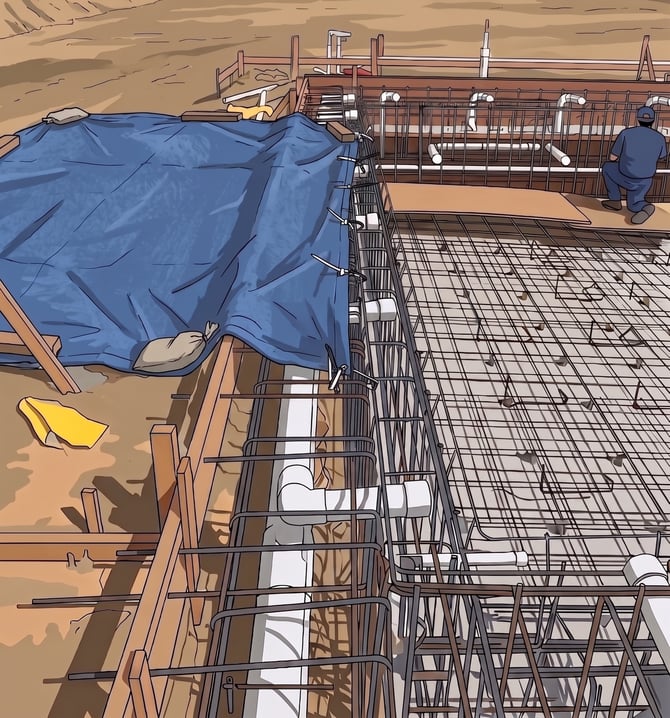
Water that enters the excavation itself should be captured by a bed of gravel and pumped out of the deepest point with a submersible pump (see article [here](https://watershape.com/knowledge-base/how-do-we-keep-water-out-of-an-open-excavation?hsLang=en-us)).
- [FAQs](https://watershape.com/knowledge-base/faqs?hsLang=en-us#main-content)
- [Reinforced Concrete](https://watershape.com/knowledge-base/faqs?hsLang=en-us#reinforced-concrete)
- [Marketing](https://watershape.com/knowledge-base/faqs?hsLang=en-us#marketing)
- [Troubleshooting](https://watershape.com/knowledge-base/troubleshooting?hsLang=en-us)
- [Construction](https://watershape.com/knowledge-base/construction?hsLang=en-us)
[](https://watershape.com?hsLang=en-us)
[mailto:email@email.com](mailto:email@email.com)
Copyright © 2026, Watershape Consulting Inc.